Conformal Cooling For Injection Molds
Brown Tool & Mold produces conformal cooling inserts for injection molds using the Xact Metal XM200G powder bed fusion system. Conformal cooling channels follow part geometry — delivering more uniform heat extraction than straight-drilled waterlines and potential cycle time reductions of 30–50% in qualifying programs.
What Is Conformal Cooling?
Cooling time accounts for 60–80% of total injection molding cycle time in most applications. Conformal cooling addresses this directly by placing cooling channels that precisely follow the contour of the part geometry — impossible to achieve with conventional drilling.
In conventional injection mold cooling, waterlines are drilled straight through the mold steel. These straight channels cannot follow the shape of complex part geometry — deep cores, thin ribs, curved surfaces, and tight corners all create areas where coolant cannot reach effectively. The result is uneven cooling, extended cycle times, and warpage in finished parts.
Conformal cooling channels are produced through metal 3D printing — specifically powder bed fusion — which allows channels to be designed in any shape and positioned at a uniform distance from the mold cavity surface. This brings coolant closer to the part in critical areas, extracts heat more uniformly, and eliminates the hot spots that extend cycle time and cause dimensional problems.
Brown Tool & Mold produces conformal cooling inserts on the Xact Metal XM200G powder bed fusion system at our facility in Nebo, North Carolina. Inserts are produced from tool steel powder and finished to mold-quality dimensions on our CNC and grinding equipment.
Why Cooling Time Dominates
Straight-Drilled vs. Conformal Cooling
The right cooling strategy depends on part geometry, production volume, and cycle time requirements. Brown Tool & Mold evaluates both options for every program.
Straight-Drilled Cooling
Traditional drilled waterlines are cost-effective for simpler geometries and lower-volume programs. Well-engineered straight-drilled systems can deliver excellent performance at lower tooling cost.
- Lower tooling cost — no additive manufacturing required
- Suitable for simple to moderate part geometry
- Proven, well-understood manufacturing process
- Cannot follow complex curves, deep cores, or tight geometry
- Uneven cooling on complex parts — hot spots and warpage risk
- Longer cycle times on high-complexity or high-volume programs
Conformal Cooling
Metal 3D printed conformal channels follow part geometry at a uniform distance from the cavity surface — delivering more uniform heat extraction and potential significant cycle time reduction.
- Channels follow part geometry — impossible with conventional drilling
- More uniform heat extraction across the entire cavity surface
- Potential 30–50% cycle time reduction on qualifying programs
- Reduced warpage on complex geometry and thin-wall parts
- Higher upfront tooling investment — offset by production savings
- Best suited for high-volume programs and complex part geometry
How We Produce Conformal Cooling Inserts
Brown Tool & Mold produces conformal cooling inserts on the Xact Metal XM200G powder bed fusion system at our Nebo, NC facility — finished to mold-quality tolerances on our CNC and grinding equipment.
Cooling Analysis
Thermal analysis of the part and mold geometry using Moldex3D simulation identifies hot spots, uneven cooling zones, and areas where conformal channels will deliver the greatest cycle time improvement.
Channel Design
Conformal cooling channels are designed to follow the part contour at a uniform distance from the cavity surface. Channel diameter, pitch, and flow path are optimized for turbulent flow and maximum heat transfer.
3D Printing
The conformal insert is produced on the Xact Metal XM200G powder bed fusion system from tool steel powder. Layer-by-layer construction allows channel geometry impossible to achieve any other way.
Finishing & Integration
The printed insert is stress-relieved, finish-machined on our CNC equipment, and ground to mold-quality tolerances. It is then integrated into the mold assembly and pressure-tested before mold sampling.
When Conformal Cooling Makes Sense
Conformal cooling delivers the greatest return in specific program types. Brown Tool & Mold evaluates every mold program individually to determine whether conformal cooling justifies the additional tooling investment.
High-Volume Production
When annual production volumes are high, even a 20–30% cycle time reduction translates directly into significant cost savings per part and additional press capacity. The payback period on conformal tooling investment is often short on high-volume programs.
Complex Part Geometry
Deep cores, thin ribs, enclosed geometry, curved surfaces, and tight corners all create cooling challenges that straight-drilled waterlines cannot address effectively. Conformal channels can reach these areas and cool them uniformly.
Medical & Precision Parts
Parts with tight dimensional tolerances and low warpage allowances benefit from the uniform heat extraction that conformal cooling provides. More consistent cooling means more consistent part dimensions and fewer rejects.
Thin-Wall Applications
Thin-wall parts are particularly sensitive to non-uniform cooling. Hot spots cause differential shrinkage and warpage. Conformal channels positioned uniformly around the cavity minimize temperature gradients across the part.
Engineering Resins
High-performance resins — PEEK, PPS, Nylon, glass-filled materials — often require precise mold temperature control to achieve proper crystallization and dimensional stability. Conformal cooling improves temperature uniformity with these materials.
Offshore Mold Programs
Conformal cooling inserts produced by Brown Tool & Mold can be integrated into globally sourced molds — combining lower offshore tooling cost with domestic conformal cooling capability and MoldGuard™ warranty coverage.
Xact Metal XM200G System
Brown Tool & Mold produces conformal cooling inserts on the Xact Metal XM200G powder bed fusion system — a precision metal additive manufacturing platform designed specifically for tooling applications.
The XM200G builds parts layer by layer from metal powder using a laser — allowing internal channel geometries that are impossible with any subtractive manufacturing process. BTM's XM200G system means faster lead times and direct engineering control over the insert design and production process.
After printing, inserts are stress-relieved and finish-machined on BTM's CNC and precision grinding equipment to achieve the tolerances required for integration into the mold assembly.
View Metal 3D Printing Services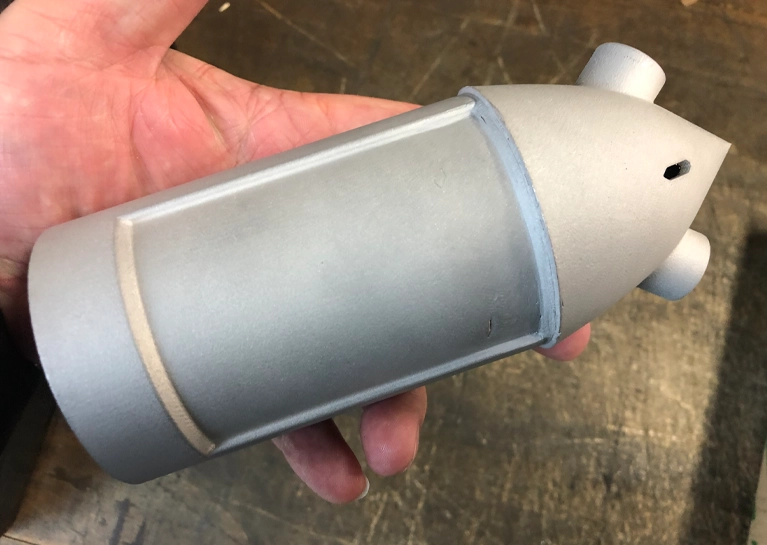
Conformal Cooling FAQ
How much can conformal cooling reduce cycle time?
Potential cycle time reductions of 30–50% are possible in qualifying programs — particularly those with complex part geometry, deep cores, or high production volume. Actual results vary by part geometry, material, wall thickness, and current cycle time. BTM evaluates each program individually using Moldex3D simulation to estimate the potential benefit before committing to conformal tooling investment.
What material are conformal cooling inserts made from?
Brown Tool & Mold produces conformal cooling inserts from tool steel powder on the Xact Metal XM200G powder bed fusion system. The inserts are stress-relieved after printing and finish-machined to mold-quality tolerances. Material selection is confirmed based on the mold's operating requirements.
Is conformal cooling worth the additional cost?
For the right program, yes — typically high-volume programs, complex part geometry, or programs where part quality issues are driven by uneven cooling. The payback period depends on annual production volume, cycle time reduction achieved, and press rate. BTM can model the ROI for your specific program before you commit to the investment.
Can conformal cooling be added to an existing mold?
In many cases yes — conformal cooling inserts can be retrofitted into existing molds where the geometry allows. This is evaluated case by case. Contact BTM with your mold information and we can assess whether retrofit conformal cooling is feasible for your tooling.
Is conformal cooling available on offshore molds?
Yes. BTM can produce conformal cooling inserts domestically and integrate them into globally sourced molds from our partners in China, Vietnam, and Malaysia. All molds — domestic or offshore — are covered under the MoldGuard™ warranty.
Does BTM use simulation to design conformal cooling?
Yes. Brown Tool & Mold uses Moldex3D simulation to analyze cooling performance, identify hot spots, and optimize conformal channel placement before any steel is cut or powder is melted. This front-end engineering investment ensures the conformal cooling design delivers real performance improvement.
Ready to Discuss Conformal Cooling?
Send us your part files and production requirements. Our engineering team will evaluate whether conformal cooling makes sense for your program and provide a detailed analysis.